
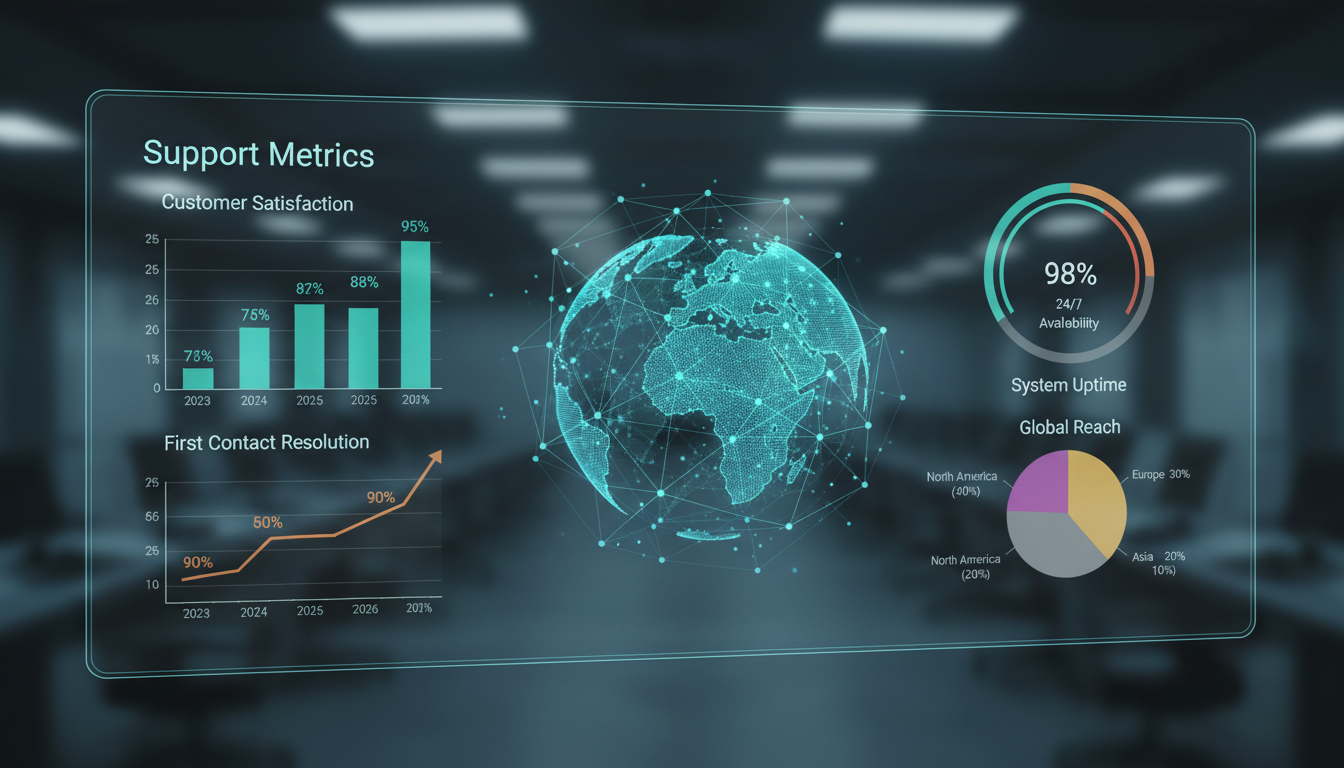
Support Metrics That Matter in 2026
Businesses that rely on structured customer support services must track the right metrics to ensure long-term scalability and customer loyalty.
The focus has shifted from volume-based measurements to value-based performance indicators.
First Contact Resolution (FCR)
High FCR reduces ticket backlog, improves satisfaction, and lowers operational costs. Customers value efficiency and clarity—resolving issues quickly strengthens trust.
A strong FCR rate indicates well-trained agents and structured knowledge systems.
Customer Satisfaction Score (CSAT)
In modern support environments, CSAT is often combined with sentiment analysis tools to gain deeper insight into customer perception.
High CSAT correlates directly with stronger retention and brand loyalty.
Net Promoter Score (NPS)
Support teams play a direct role in influencing NPS by delivering consistent, empathetic, and accurate solutions.
When support is aligned with strategic business process outsourcing, NPS improvements often follow operational consistency.
Average Resolution Time (ART)
In 2026, businesses prioritize resolution efficiency over simple response speed. Quick replies without proper resolution no longer meet customer expectations.
ART helps identify workflow bottlenecks and training gaps within support teams.
Customer Effort Score (CES)
Customers expect seamless interactions across chat, email, and phone channels. Integrated 24/7 live chat customer support helps reduce friction and improve CES scores.
Lower effort equals higher loyalty.
Support Cost Per Ticket
In 2026, automation tools, knowledge bases, and proactive support strategies reduce cost per ticket while maintaining quality.
Efficient cost management ensures scalability without sacrificing customer experience.
Proactive Support Rate
Businesses that monitor system alerts, customer behavior patterns, and service disruptions reduce incoming ticket volume and strengthen retention.
Proactive support transforms operations from reactive problem-solving into strategic experience management.
Conclusion
The right KPIs provide clarity, scalability, and measurable improvement in customer retention.
Ready to optimize your support performance? Get a Quote and let Mahimedia Solutions design a data-driven support strategy aligned with modern performance standards.